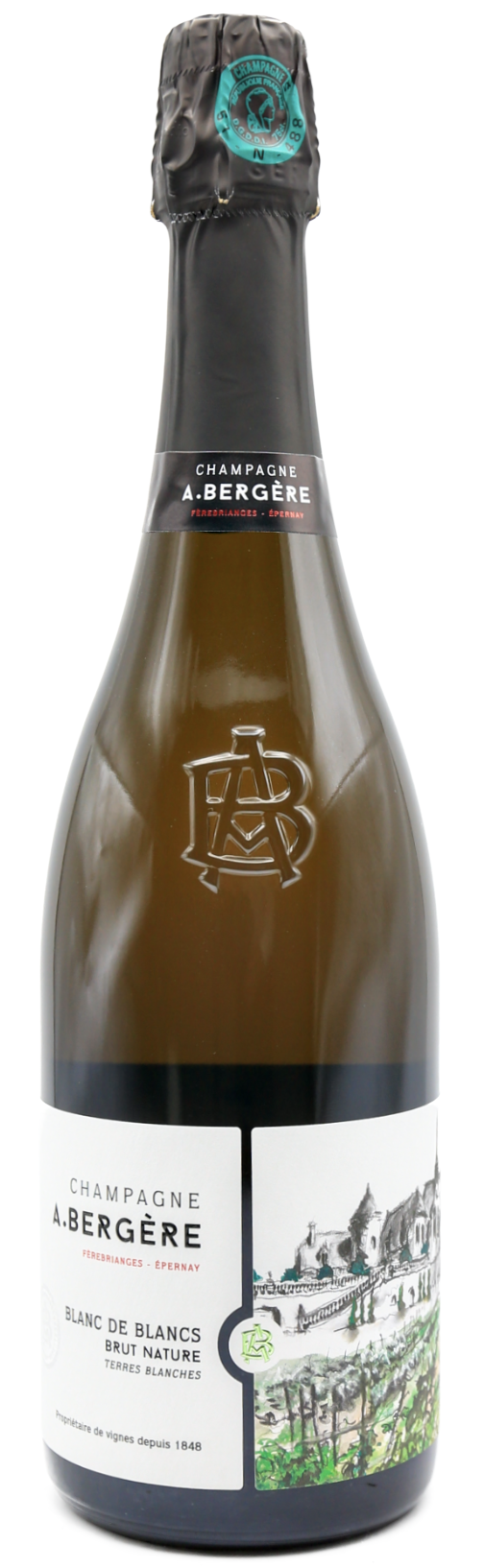
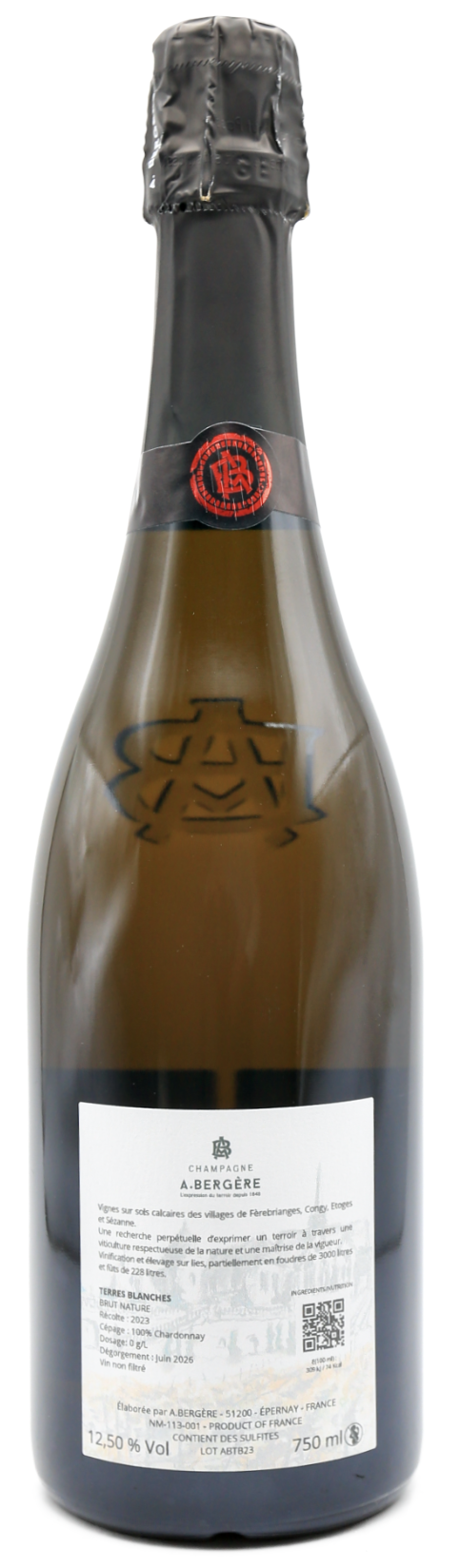
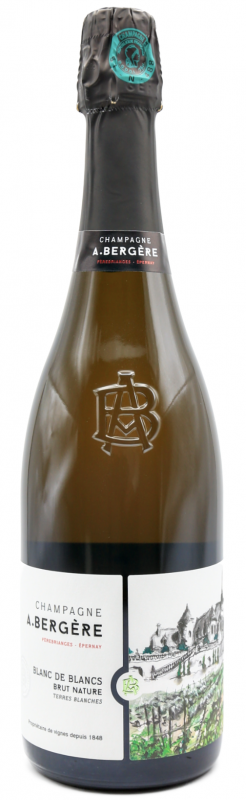
Champagne A. Bergère - Blanc de Blancs Terres Blanches Brut Nature
In Fèrebrianges, in the Petit Morin Valley, the Bergère family has been making champagne for several generations, with an approach that increasingly emphasizes the identity of the plots and the precision of the vinifications. The estate developed around its family cradle before extending its vineyard towards Étoges and Congy, allowing notably to work different expressions of Chardonnay. The Terres Blanches cuvée fits into this plot-specific research with a clearly defined origin around Fèrebrianges, Étoges, and Congy. In this southern part of Champagne, Chardonnay finds a favorable ground for straight, floral, and fresh expressions. The choice of Brut Nature accentuates this reading of the wine by practically eliminating any dosage intervention: here, no sugar is added after disgorging. The cuvée thus favors clarity, tension, and freshness rather than an artificially brought sensation of roundness. It is a particularly interesting style of champagne to appreciate the aromatic precision of Chardonnay and the personality of the Petit Morin Valley.
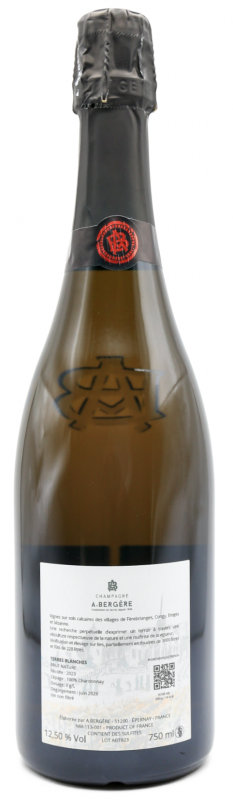
Terres Blanches is made exclusively from Chardonnay and has a dosage of 0 g/l, which classifies it in the Brut Nature category. The harvest indicated by the House for the recent edition is 2021, with disgorgement in November 2023 according to the information available on this edition. The wine is presented as unfiltered, a choice that allows preserving more of the natural matter and texture of the champagne. The House describes this cuvée through three places in the Petit Morin Valley: Fèrebrianges, Étoges, and Congy, whose different expressions are united in an exclusively white blend. The low dosage particularly highlights the freshness and structure of the wine, without trying to round off its perception. The aging and time spent on lees nevertheless bring enough relief so that this dryness does not translate into an austere mouthfeel. The result is a Blanc de Blancs that focuses primarily on fruit precision, aromatic finesse, and a sensation of persistent tension.
The clear and bright robe accompanies a precise nose, dominated by white flowers and white-fleshed fruits, with citrus nuances that appear gradually. On the palate, the attack is straight and tense, immediately carried by lemon and a saline freshness that recalls the mineral dimension of the wine. The texture nevertheless retains a certain tactile softness, which allows the Brut Nature to avoid the strict or angular register that very low-dosage champagnes can sometimes take. As the wine opens, the finish gains length and returns to citrus with a slight iodized sensation, then a particularly refreshing tangy touch. This structure makes it a champagne more intended for the table than for a tasting based solely on the pleasure of the bubbles. It will accompany precisely oysters, a scallop carpaccio, simply roasted sea bass, turbot, or noble fish served without too strong a sauce. Served around 8 to 10 °C, it can also evolve in a sufficiently open white wine glass, allowing the Chardonnay to gradually develop its floral, lemony, and saline nuances.
Grape variety: 100% Chardonnay