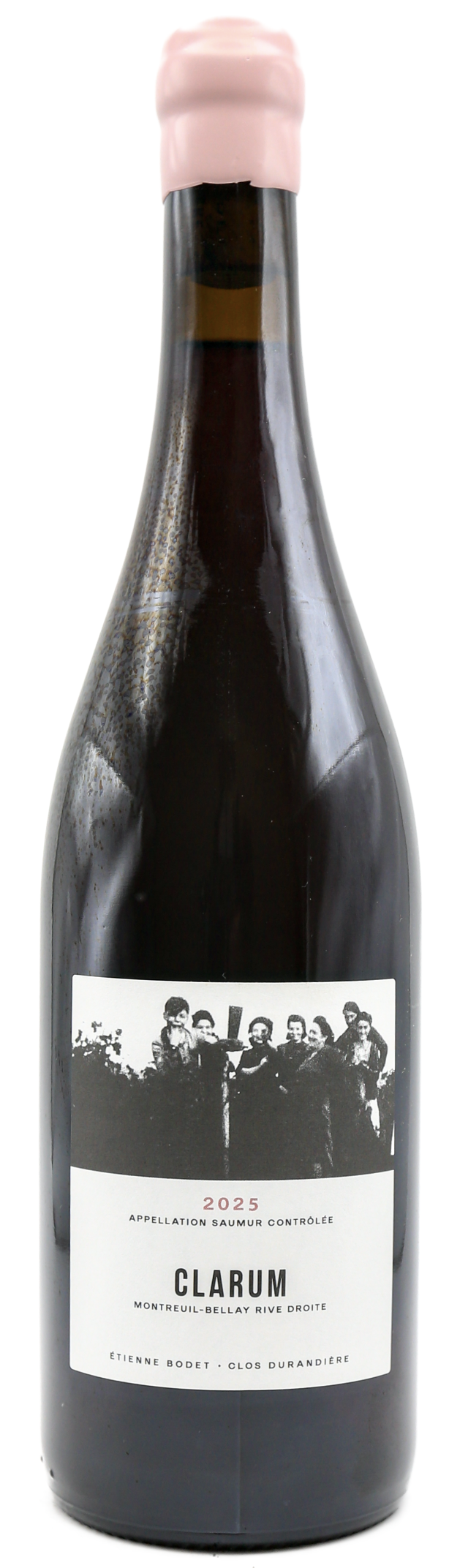
Etienne Bodet - Clos Durandière - Clarum 2025
Based in Montreuil-Bellay, south of Saumur, Etienne Bodet belongs to a new generation of winemakers who are deeply renewing the expression of the great terroirs of the Loire Valley. Coming from a family of winegrowers, he trained with several prestigious references, notably Pierre Gerbais in Champagne, Sylvain Pataille in Burgundy, and Clos Rougeard in Saumurois. Graduated in oenology in Reims, he created his own estate in 2020 with the ambition to reveal particularly unique Jurassic terroirs, different from the tuffeau formations traditionally associated with the Saumur appellation. His work is based on meticulous viticulture inspired by biodynamics, low-intervention vinifications, and particular attention to the precision of aging. The Clarum cuvée originates from Clos des Vaudelles, a plot of old vines mostly planted in 1972, on grey Oxfordian marls covered by a significant layer of clay. This deep and fresh terroir, located near Clos Durandière, has a particularly original geological identity. With Clarum, Etienne Bodet reconnects with the historical tradition of Montreuil-Bellay clairets, those light and delicately colored red wines that once held an important place in local production. Created in 2023 in a confidential quantity of about 300 bottles, this cuvée has gradually established itself as a wine in its own right, combining the gourmandise of a short maceration red with the depth and complexity of a true terroir wine.
The Clarum 2025 is made from Cabernet Franc from the old vines of Clos des Vaudelles. The 2025 vintage, marked in the Loire Valley by hot summer periods and relatively early ripening, allowed for expressive grapes, whose harvest at moderate maturity is particularly suitable for the style sought for this cuvée. Unlike the estate's great aging reds, which benefit from long macerations and extended aging, Clarum is based on a deliberately different approach, favoring delicacy of extraction and aromatic freshness. The grapes undergo a very short maceration, about two to three days, allowing for a translucent ruby color and a particularly supple tannic structure. Fermentation occurs spontaneously under the action of indigenous yeasts, respecting the estate's low-intervention philosophy. After a gentle pressing, the wine continues its fermentation and aging in already used oak barrels for about ten months. This time in wood, long enough to bring depth and refine the texture, does not seek to impose toasted or vanilla aromas. The use of sulfur remains extremely limited, with a total content announced at about 15 mg/L. This original vinification gives birth to a wine halfway between the traditional clairet and the great Loire red, where the apparent lightness of color contrasts with a true depth of flavor.
The Clarum 2025 reveals a clear and bright ruby robe, with delicately garnet reflections, evoking more a traditional clairet than a classic Saumur Cabernet Franc. Its particularly seductive bouquet opens with aromas of fresh strawberry, raspberry, and crunchy cherry, accompanied by floral nuances of violet and peony. On aeration, fine notes of spices, delicate pepper, and wet stone enrich this fruity expression, revealing an unexpected complexity for a wine of this color. On the palate, the attack is juicy and airy, carried by a supple body that maintains remarkable aromatic intensity. The fruit unfolds naturally, without heaviness or excessive concentration, while a lively and perfectly integrated acidity brings an immediate freshness sensation. The delicately enveloping texture has a vinous dimension that distinguishes Clarum from a simple maceration rosé, with a subtle structure and depth that gradually reveal themselves. The particularly salivating finish extends on notes of fresh red fruits, fine spices, and an almost saline stony sensation, evoking by its tension that of a great Loire white. More precise and more slender than the first editions of the cuvée, Clarum 2025 asserts a decidedly gastronomic personality, where the finesse of Cabernet Franc meets the originality of a clairet vinification. Served slightly chilled, it will ideally accompany a country terrine, a pâté en croûte, a roasted farm poultry, a veal fillet, a half-cooked tuna, or grilled vegetables with fresh herbs.
Grape variety: Cabernet Franc