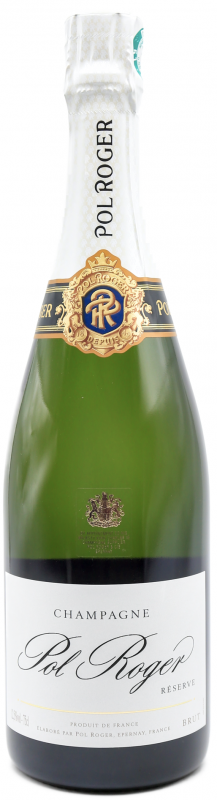
Pol Roger - Brut Reserve
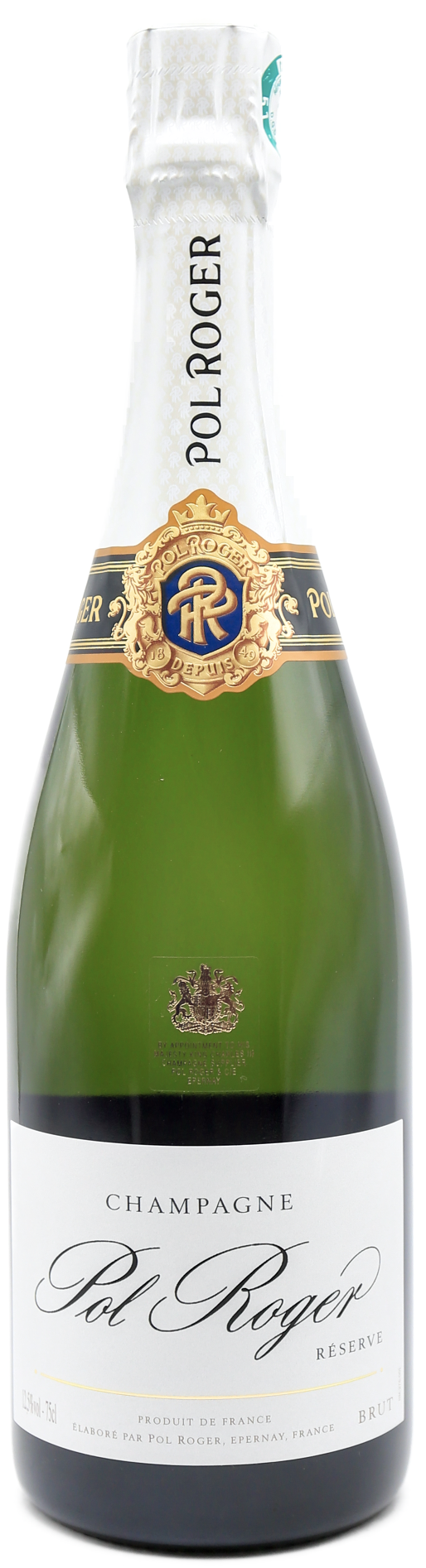
Founded in Épernay in 1849, the Pol Roger House has built its identity on champagnes where structure and vinosity combine with a consistently clear freshness. The Brut Reserve is its most emblematic expression, designed to reproduce year after year a precise style without depending on a particular vintage. Its blend is equally based on Pinot Noir, Pinot Meunier, and Chardonnay, sourced from 30 Champagne crus. The Pinot Noir, mainly from the Montagne de Reims, provides structure and depth; the Meunier, notably from the Vallée de la Marne and the Épernay area, brings fruit, suppleness, and freshness; the Chardonnay, from Épernay and the Côte des Blancs, stretches the whole with its finesse. About 25% of reserve wines participate in the blend, giving the champagne more relief and continuity. After four years of aging in the cellar, the Brut Reserve thus has an already affirmed maturity while retaining the tension that characterizes the house style.
The wine’s construction is based on separate vinification of grape varieties and crus, carried out in temperature-controlled stainless steel tanks at low temperature to preserve the clarity of the fruit. After cold settling, alcoholic fermentation takes place around 18 °C, then all the house’s wines undergo malolactic fermentation. The blending then occurs before bottling, where the second fermentation and aging continue in Pol Roger’s cellars, located 33 meters underground. Each bottle is traditionally hand-riddled before disgorging and dosage, then benefits from at least three more months of rest before marketing. This long maturation partly explains the already smooth character of the Brut Reserve, whose fruity notes gradually enrich with floral, brioche, and vanilla nuances. The interest of this cuvée lies precisely in this balance between immediacy and depth: it maintains a clear reading of the fruit while possessing enough substance to truly accompany a meal.
The straw-yellow robe reveals abundant and fine effervescence, while the nose opens on pear and ripe fruits before gaining nuances of honeysuckle, white jasmine, brioche, and vanilla. The attack is frank and dynamic, then the palate gradually gains volume with a structured, fresh, and delicately creamy texture. Cooked fruits, quince, and apricot mingle with notes of beeswax and acacia honey, before touches of candied orange, mandarin, and mild spices extend the finish. The vinosity of Pinot Noir gives the champagne a pleasant base, while the Chardonnay provides the necessary momentum to maintain a sensation of freshness until the end. As an aperitif, it naturally finds its place alongside some iodized bites, but its structure especially allows it to be extended at the table with scallops, roasted fish, poultry with morels, or sweetbreads. Served around 8 to 10 °C, it can also accompany a meal entirely dedicated to champagne, evolving progressively in the glass and revealing more of its pastry and spicy nuances.
Grape varieties: 1/3 Pinot Noir, 1/3 Pinot Meunier, 1/3 Chardonnay