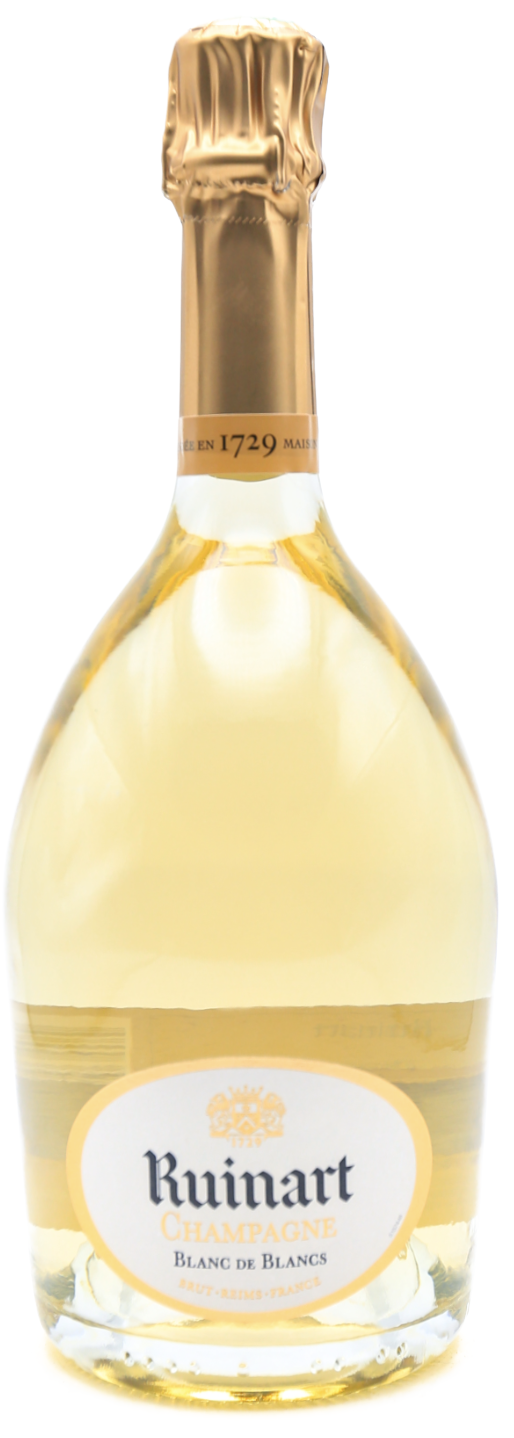
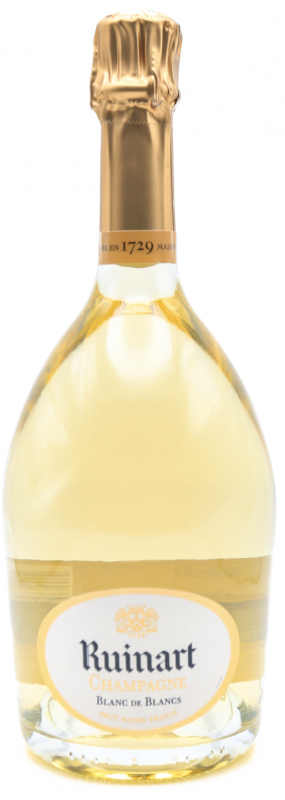
Champagne Ruinart Blanc de Blancs
Founded in Reims in 1729, Ruinart has maintained since its origins a privileged relationship with Chardonnay, which has become the true guiding thread of its style. The Blanc de Blancs is the most obvious expression of this: entirely made from this grape variety, it favors brightness, aromatic finesse, and a texture that is both fresh and enveloping. The blend brings together Chardonnays from 25 to 30 crus, mostly located in the Côte des Blancs, but also in the Montagne de Reims, the Sézannais, and the Vesle Valley. This diversity allows the creation of a more nuanced wine than a simple blend centered on a single terroir, by combining different expressions of Champagne Chardonnay. The House thus seeks a precise balance between tension and roundness, without sacrificing the delicacy that is one of Ruinart's historical characteristics. This cuvée naturally occupies a central place in the range, with a style immediately identifiable by its aromatic freshness and elegance.
The grapes are hand-harvested before alcoholic fermentation is carried out in temperature-controlled stainless steel tanks, followed by malolactic fermentation. The blend includes 20 to 30% reserve wines from different vintages, which adds more depth while maintaining the continuity of the House style. After the secondary fermentation, the wine rests for two to three years in the cellar, during which the texture refines and the different components of the blend gradually merge. The dosage of 7 g/l preserves a certain roundness without weighing down the fresh structure of the Chardonnay. The terroir thus remains at the forefront, with an expression more focused on the precision of citrus and fresh fruits than on strongly toasted or woody notes. This structure explains the particularly versatile character of the Blanc de Blancs, capable of being airy as an aperitif while possessing enough substance to accompany a meal.
The pale yellow, luminous robe presents slight green reflections that emphasize the freshness of the wine. The nose opens on ripe citron, juicy pear, and fresh peach, before gaining nuances of white flowers, ginger, and pink peppercorn. On the palate, the Chardonnay is both precise and enveloping, with a supple texture crossed by the freshness of ripe citrus and exotic fruits. The balance relies less on sharp acidity than on a delicate tension, which gives length to the finish while maintaining a sensation of roundness. The persistence returns to citrus and fresh fruits with a slightly saline touch, particularly pleasant at the table. This champagne will naturally find its place with oysters, shellfish, a sea bass carpaccio with citrus, scallops, or simply roasted fish, but can also accompany more elaborate cuisine based on crustaceans. Served around 8 °C, ideally in a tulip glass or a sufficiently open white wine glass, it will gradually gain aromatic expression throughout the tasting.
Grape variety: 100% Chardonnay