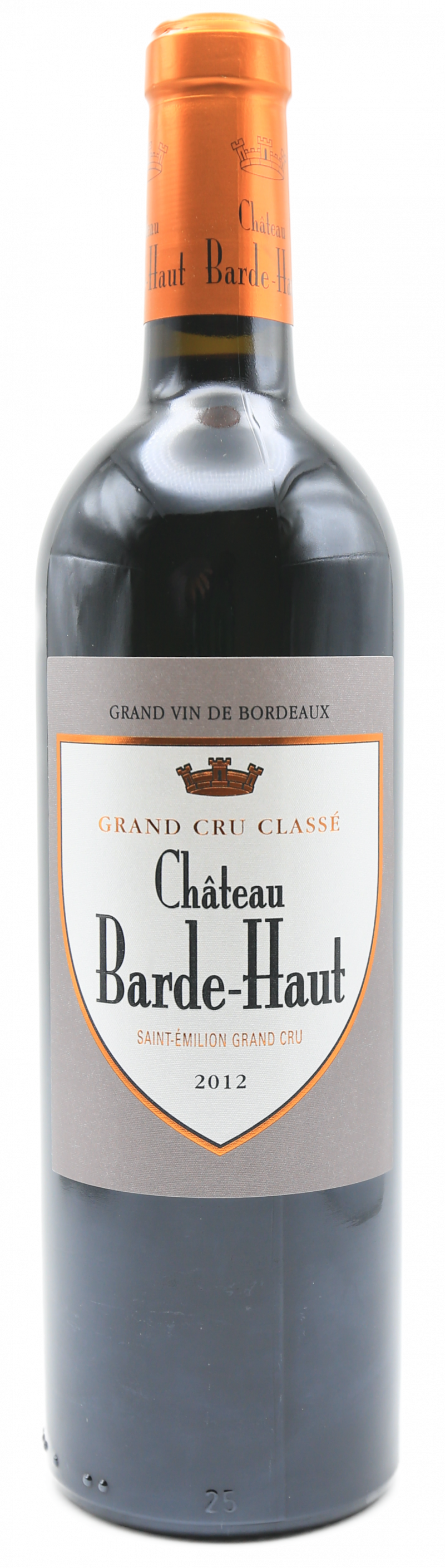
Château BARDE HAUT 2012
At the eastern end of the Saint-Émilion plateau, in Saint-Christophe-des-Bardes, Château Barde-Haut occupies a natural amphitheater facing due south, overlooking the Dordogne valley. The estate, whose earliest records date back to the late 18th century, experienced a new momentum after its acquisition by Sylviane Garcin-Cathiard in 2000, before joining the classification of Saint-Émilion Grands Crus Classés in 2012. The vineyard, contiguous in one piece, extends over about twenty hectares according to sources and is mainly based on clay-limestone soils established on a limestone bedrock. This geology provides the wine with a mineral foundation that complements the natural generosity of Merlot. The facilities modernized in the early 2000s allow for parcel vinification and respectful handling of the harvest, in small-volume vats. The whole produces fleshy and deep Saint-Émilions, where the ripeness of the fruit is accompanied by a search for freshness and definition. The 2012 vintage thus has a particular historical dimension for the estate as it corresponds to the official entry of Barde-Haut into the Grands Crus Classés classification.
Primarily made from Merlot complemented by Cabernet Franc, the 2012 clearly expresses the sunny personality of this southern Saint-Émilion terroir, without sacrificing the structure that ensures the longevity of great right-bank wines. The selection carried out in the vineyard and the vinification conducted in containers of different materials help preserve the precision of the fruit while building a broad texture. The oak aging, important in the estate's style, accompanies the wine with toasted and spicy notes that have gradually integrated over time. After more than a decade in bottle, this cuvée has gained depth and patina, giving more room to tertiary nuances than to the purely fruity expression of its youth. The 2012 vintage, less demonstrative than the great Bordeaux years of the decade, finds particular interest here in its balance and harmonious evolution. It is a wine that well illustrates the meeting between the velvety texture of Merlot, the freshness brought by the limestone, and the firmer framework of Cabernet Franc. Today, its interest lies precisely in this maturity phase where the black fruit begins to dialogue with more complex notes of undergrowth and spices.
The dark garnet robe reveals a discreet evolution on the edge of the glass, while the nose opens on blackberry, black plum, and ripe cherry before sliding towards undergrowth, blond tobacco, sweet spices, and delicate roasted nuances. On the palate, the body remains fleshy, with a soft attack and broad texture, but the freshness provides enough drive to keep the whole in a balanced register. The tannins, now softened by aging and years in bottle, retain a structuring presence without harshness. The finish prolongs the flavors of black fruits and cocoa on a slightly earthy and spicy touch, with the savory persistence characteristic of Saint-Émilions that have reached maturity. It can be enjoyed now after sufficient decanting, especially with a roasted rack of lamb, a beef fillet, a veal cut with mushrooms, or game birds. Its texture and evolved accents also pair very well with duck breast accompanied by a black fruit reduction. A serving temperature around 16 to 18 °C will preserve the wine's freshness while fully expressing its tertiary nuances.
Grape varieties: Merlot, Cabernet Franc